Your Cart is Empty




That bra that fits beautifully in the cups but feels too tight around your ribs is not necessarily the wrong bra. It may simply be the wrong band size. This guide to bra sister sizing explains how to make a smart adjustment without giving up the cup capacity and coverage you need.
Sister sizing is especially helpful when you are close to the right fit but something feels off: the band rolls, the cups wrinkle, the straps dig in, or a style you love does not come in your usual size. The goal is not to chase a label. It is to find support that stays put, smooths comfortably, and helps your clothes fall the way you want them to.
Bra sister sizes are sizes with roughly the same cup volume on different band sizes. When the band size goes down, the letter must go up to keep a similar cup capacity. When the band size goes up, the letter must go down.
For example, if you normally wear a 36C, your closest sister sizes are 34D and 38B. All three offer a similar cup volume, but they do not feel identical. The 34D has a firmer, shorter band. The 38B has a longer, more relaxed band.
This is where many fit frustrations begin. A D cup is not automatically larger than a C cup in every bra. Cup letters are relative to the band. A 34D and a 38D have very different cup volumes, which is why the number and letter always need to be considered together.
The simplest rule is this: go down one band size and up one cup letter, or go up one band size and down one cup letter.
If you wear a 34DD, the closest options are 32DDD and 36D. If you wear a 40C, look to 38D for a firmer band or 42B for a roomier one. Make only one step at a time whenever possible. Moving two band sizes changes much more than the label. It can affect where the straps sit, how the center front rests, and how securely the bra supports your bust.
Sister sizing is a fitting tool, not a rule that every bra must follow. Different materials, cup shapes, and support systems can make the same size feel noticeably different from one style to the next.
Sister size down when the cups are right but the band is too loose. A band that rides up your back, shifts throughout the day, or needs to be fastened on the tightest hooks from the start is not doing enough of the support work.
For instance, if a 38C fits well in the bust but the band creeps upward, try a 36D. You keep similar cup volume while gaining a firmer foundation. This can be a particularly useful adjustment for women who find that traditional narrow bands roll or create a visible line beneath fitted tops.
A supportive band should sit level around your torso and feel snug, not punishing. You should be able to take a full breath and move comfortably. If sizing down makes you feel squeezed or creates new bulging at the sides, the issue may be the bra's construction rather than the band number alone.
Sister size up when the cups fit but the band feels uncomfortably tight. If you are wearing a 34D and the band feels restrictive, a 36C may offer the breathing room you need while maintaining similar cup capacity.
This can be useful with firmer fabrics, new bras that have very little stretch, or styles designed with a more compressive feel. It can also help when you are between sizes. Still, be careful not to use a larger band to solve a cup problem. If breast tissue spills over the top or sides of the cups, the cup is likely too small. Going to a larger band with a smaller letter may make that problem worse.
For a comfort-first fit, the best answer is often a bra designed to distribute support across a wider area. Shapeez back-smoothing styles are built to help reduce the pressure points and visible lines that can make a conventional bra feel tighter than it should.
Before reaching for a sister size, check the fit of your current bra while standing naturally. Put it on using the loosest hook when it is new, then lean forward and gently guide breast tissue into the cups. This helps you assess the fit based on where your body actually needs support.
If the band rides up your back, feels loose, or you can pull it far away from your body, try sister sizing down. If the band digs in all the way around but the cups fit smoothly, try sister sizing up.
Cup clues matter just as much. Wrinkling or gaping often means the cup is too large, too tall, or the wrong shape for your bust. Overflow at the neckline or sides usually means you need more cup volume. A center front that floats away from the body can indicate that the cups are too small, though some wire-free and full-coverage designs are intentionally constructed differently.
Straps should provide a gentle lift, not carry the entire weight of the bust. If they leave deep marks or slip repeatedly, look at the band fit first. Tightening straps to compensate for a loose band only creates more discomfort.
A sister size preserves approximate cup volume, but it cannot create the same bra in a different label. The band is longer or shorter, the straps may sit farther apart or closer together, and the cups can have a slightly different footprint on the chest.
This matters for fuller busts, softer breast tissue, narrow shoulders, and anyone who prefers more side coverage. A 36D may hold similar volume to a 34DD, but the 36D can feel wider through the sides and less anchored around the ribs. For some women, that is exactly the relief they need. For others, it means less lift and more movement.
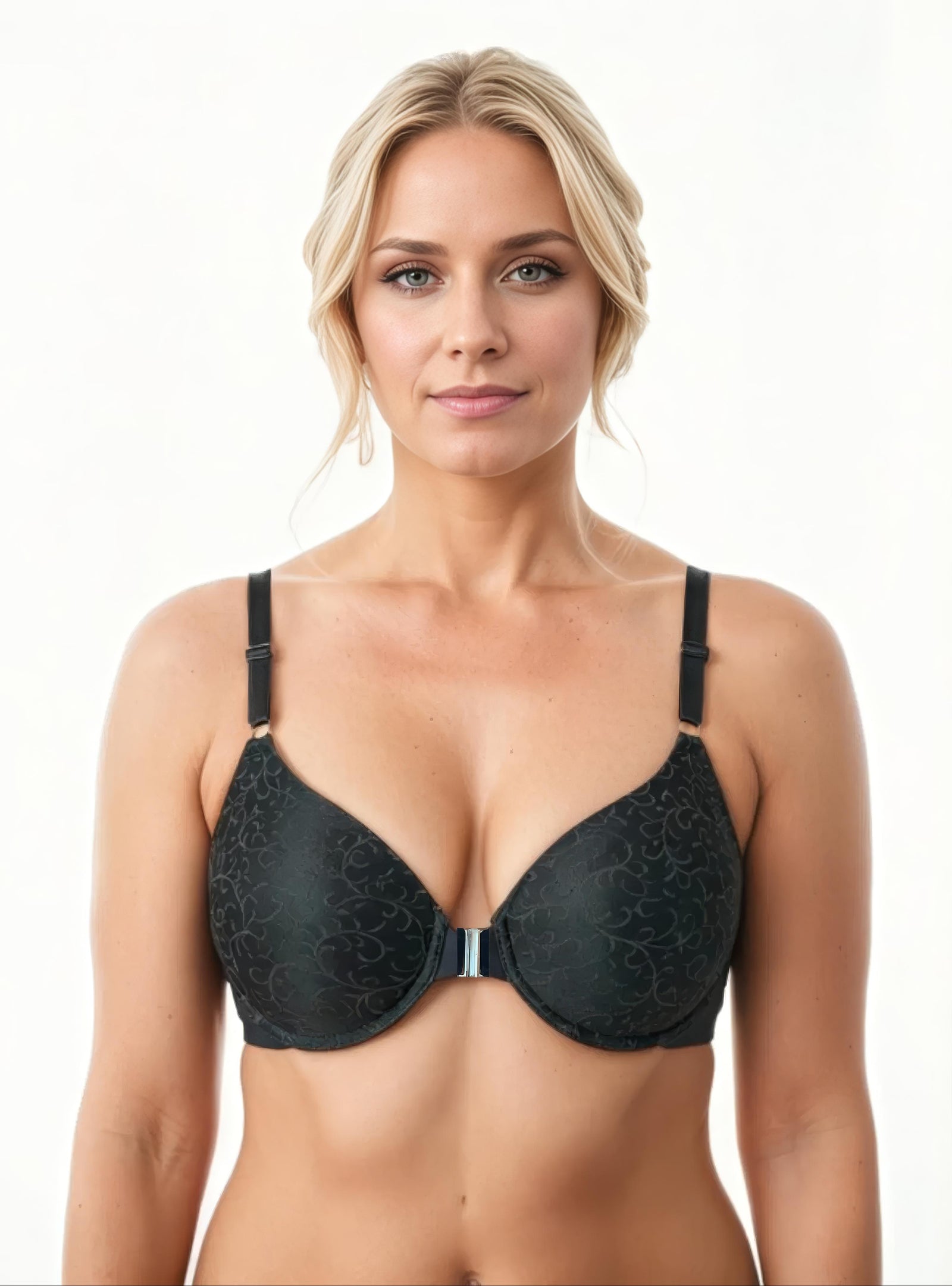
The bra style matters, too. A molded foam cup may gap when you move even if the volume is correct. A flexible, non-foam cup may conform more closely. Front-closure bras, longline silhouettes, minimizers, and smoothing bras each distribute tension differently, so trust the mirror and your comfort over a number on the tag.
Start with the size that comes closest to your usual fit. If the band is the only problem, try one sister size in the direction you need. Wear it for several minutes, sit down, raise your arms, and notice whether it stays level and comfortable.
Look for a smooth cup edge, secure coverage, and a band that does not roll or climb. Under a lightweight tee or blouse, check whether the back and sides look as smooth as they feel. Support should not require constant tugging, shifting, or a deep breath before fastening the closure.
If neither sister size works, do not keep moving farther away from your starting size. Try a different silhouette or construction instead. A wider smoothing back, a more flexible cup, a front closure, or a longer torso design may solve the problem more effectively than another size change.
You can, but the fit changes quickly. A 36C can sister size to 34D, then 32DD, yet the 32DD will have a much firmer band and a different overall feel. One step is usually the most reliable adjustment.
Yes, with a little more flexibility. Wire-free bras often accommodate small fluctuations in size because the cups have more give. However, the band is still the foundation of support, so it should feel secure without digging or rolling.
Not automatically. Back bulge can happen when a band is too tight, but it can also be caused by a narrow band concentrating pressure in one spot. A smoothing bra with wider coverage may feel more comfortable and create a cleaner silhouette without sacrificing support.
Your best bra size is the one that lets you move through a full day feeling held, comfortable, and like yourself. Use sister sizing when it brings you closer to that feeling, then let the fit, not the tag, make the final call.