
Your Cart is Empty






How to Choose the Best Bra for Your Breast Shape
Discover how breast shape influences bra fit, resolve common issues like top-cup gaping and lower-cup pinching, and find all-day smoothing support.

Key Takeaways
- Cups that gap at the top but pinch below usually signal a cup that is too shallow or narrow at the base, not simply a cup that is too large.
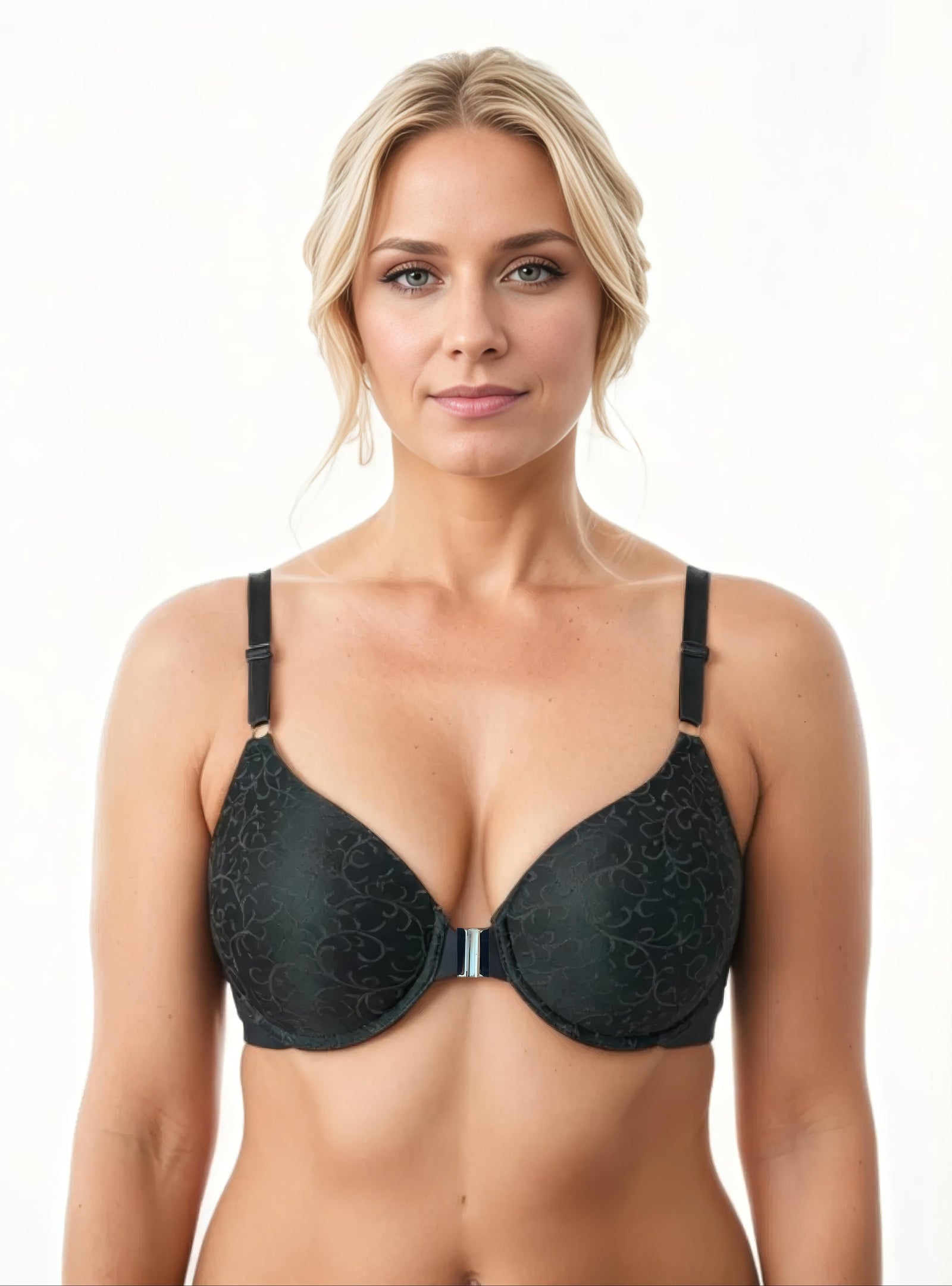
- For fuller-on-bottom breasts, a push-up cup cut low at the center lifts from the base and gapes less at the top edge than a full-coverage cup.
- A longline underwire bra distributes anchoring support across more of the torso, making it a practical option if you have a full bust, back rolls, or falling straps.
- Breast shape and bra size work together: cup volume describes how much tissue there is, while shape describes where that tissue sits and how much projection it needs.
- A supportive fit starts with a secure band and underwires that sit in the natural breast crease; straps should fine-tune the fit rather than carry most of the load.
To choose the best bra for your breast shape, you must match the cup depth and wire curvature to your tissue distribution rather than focusing solely on cup size. Selecting a style designed for your specific projection and fullness ensures the underwire stays anchored in your natural crease without pinching below or gaping at the neckline.
Loading...
Why Breast Shape Changes Bra Fit
Bra fit depends on two distinct factors: cup volume and tissue distribution. While your cup size reflects the total volume of breast tissue, your shape determines where that tissue sits, how far forward it projects, and the width of your breast root. Consequently, two people who wear the exact same nominal bra size often require entirely different cup depths, gore widths, wire arcs, and neckline profiles. A quick mirror assessment helps identify your specific profile. Observe whether your tissue is concentrated below the nipple line (fuller-on-bottom) or evenly distributed (fuller-on-top and round). Notice whether your tissue is shallow (spread across a broad base) or projected (standing forward from the chest wall), as well as your breast spacing. Natural asymmetry is completely normal; fit your bra to accommodate the larger breast and adjust straps to balance the fit.
Understanding Top-Cup Gaping with Lower-Cup Pinching
When a bra cup gaps along the top edge while pinching the ribcage underneath, the issue is rarely excess cup volume. Instead, this common fit problem indicates that the cup is too shallow or too narrow at the base. When the base lacks sufficient depth, breast tissue cannot settle down into the cup bottom, forcing the underwire to press into the ribcage while the upper cup sits empty and tilts outward. To correct this mismatch, start by checking your underwire placement to verify that the wire rests directly in the natural crease beneath each breast. Next, ensure your band is snug and level across your back, as a loose band allows the bottom of the cup to kick forward. Finally, try a cup cut lower at the center so your tissue can settle from the base.
Matching Bra Styles to Breast Shape Needs
Achieving the right fit starts by selecting cup construction built for your tissue distribution, then confirming the band provides secure, level anchoring around the torso. Rigid full-coverage molded cups can leave empty space at the upper cup edge for fuller-on-bottom profiles, whereas open-neckline cuts lift directly from the base. The following comparison highlights key features and styles suited for common breast shapes.
| Breast Shape Need | Fit Signals & Challenges | Recommended Cup Features | Recommended Styles |
|---|---|---|---|
| Fuller-on-Bottom | Upper cup gaps in full-coverage cups; tissue sits below the nipple | Push-up cups, low center front, lift from the base | Demee Short, Demee Long |
| Fuller-on-Top / Round | Spillage at cup necklines; firm tissue distributed across the upper pole | Full-coverage cups that contain the upper cup, supportive center gore | Shortee, Tankee Short |
| Shallow or Wide-Set | Tissue spread across a wide chest wall; center gaps between breasts | Cups wide enough to cover outer tissue, a center gore that sits flat; underwire or wirefree | Shortee (underwire), Comfeez Short (wirefree, fits best up to DD) |
| Full Bust / Apple Shape | Narrow bands digging in; visible back rolls, falling straps | Longline bodice, wider back panels, integrated underwire cups | Tankee Long, Silkee Long |
| Asymmetrical | One cup fits while the other gaps or spills | Fit the larger breast; shorten the front-adjustable strap on the smaller side | Shortee, Tankee Short |
Why a Longline Bra Supports a Fuller Upper Body More Evenly
A longline bra delivers superior torso stability by spreading anchoring support across the ribcage, sides, and back rather than concentrating pressure into a narrow 1-inch or 2-inch band. Traditional narrow bands frequently dig into soft tissue, creating pressure points, back rolls, and underarm bulges. As a fitting rule of thumb, the band should do most of the lifting, with shoulder straps there to fine-tune, not to carry the weight. For a fuller upper body, full bust (cups C-DDD/F), or an apple-shaped silhouette, our Tankee Long pairs molded underwire cups with a longline bodice in moisture-wicking Cool Tex fabric, and our Silkee Long uses non-foam underwire minimizer cups to reduce projection for larger cup sizes. This design provides 360° smoothing and support across the mid-torso, preventing garment roll-up and keeping shoulder straps securely in place throughout the day.
How Our Smooth-Back Design Supports Every Shape
We designed every Shapeez style to eliminate visible bra lines, muffin top, and back bulges under fitted tops by pairing cup support with our patented smooth-back design. Our co-founder Staci Berner stitched the first prototype in 2005, and we bring over 20 years of fit expertise to garments made in Canada. With no back hooks or narrow elastics, our styles provide 360° smoothing and support without layered shapewear. Our Shortee Full-Coverage T-Shirt Bra with Underwire & Adjustable Straps shows how it works: pull-on construction, molded foam cups, front adjustable no-fall straps, and moisture-wicking Cool Tex Lycra. Rated 4.91 out of 5 stars across 570 reviews, it smooths back and side bulges while keeping a natural, lifted shape.
How to Confirm Your Fit and Choose the Right Size
A properly fitted bra remains level around your ribcage, anchors the underwire directly in the breast crease, contains breast tissue without spillage or cutting in, and eliminates gaping along the neckline. When trying on a new bra, evaluate the band level, cup containment, gore contact, and strap tension. Always perform a movement test by raising your arms and bending forward, followed by checking your silhouette under a fitted top to ensure smooth lines. Avoid the outdated +4 method, which artificially inflates band measurements and leads to loose, riding-up bands. Our styles run bands XS-1X and cups AA-F, depending on the style. Measure your underbust and bust accurately, and consult the sizing guide to select your ideal fit.
