
Your Cart is Empty


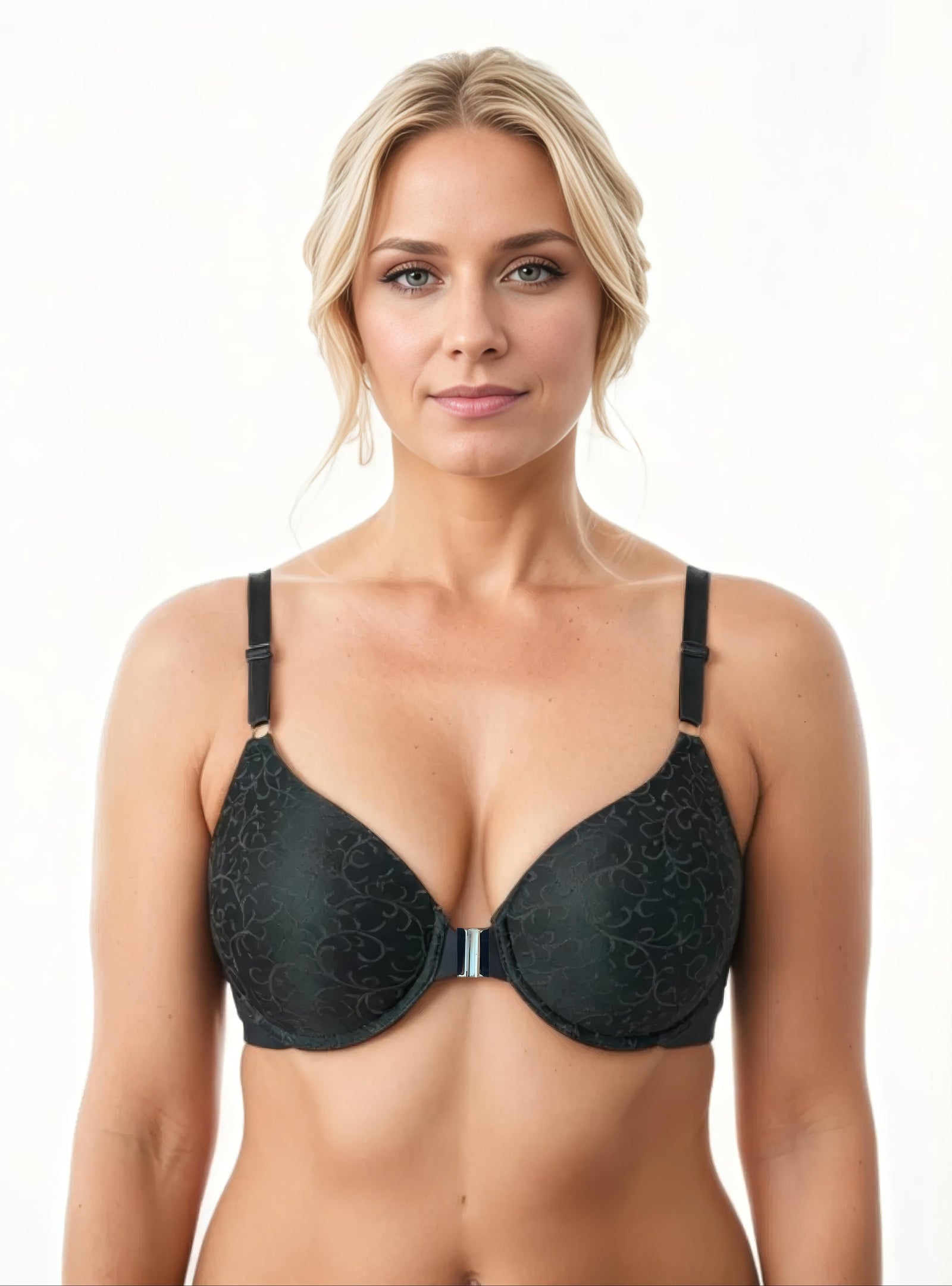




Minimizer Bra Fit Guide: Gore Placement, Armpit Coverage & Back Smoothing
Discover how a full-coverage minimizer bra should fit across the center gore without underarm spillover while eliminating back bulges.

Key Takeaways
- A properly fitted minimizer bra minimizes forward bust projection by spreading tissue across a broader cup footprint rather than squashing it.
- The center gore must tack completely flat against the sternum with zero gap; a floating bridge signals that the cup volume is too shallow or small.
- Correct cup coverage keeps side tissue out of your armpits, so the underwire sits behind your breast tissue instead of pinching your underarm.
- The Silkee Short contains a full bust with two-layer non-stretch cups, and our patented smooth-back design smooths back rolls.
- Our Silkee cups have no foam or stretch, so we recommend a bigger cup than your usual size so the gore sits flush.
A properly fitted minimizer bra sits completely flush against your sternum at the center gore while redistributing bust tissue evenly across the chest wall to reduce forward projection without pinching underarms or causing back rolls. If your bra bridge floats away from your breastbone or pushes tissue toward your armpits, you are likely experiencing cup volume restriction rather than an incorrect band size.


Silkee Short Non-Foam Full Cup Minimizer Bra w/ Underwire
$94.00
How Does a Minimizer Bra Reshape Bust Volume Without Squashing?
A good minimizer reduces forward projection while preserving natural breast separation and posture. Many women mistakenly assume that a minimizer works like a sports compression garment by forcefully flattening breast mass against the ribs. In reality, a high quality structural minimizer utilizes anatomical redistribution. It gently guides fuller breast tissue outward across a broader, shallower cup footprint toward the chest wall. This structural technique prevents blouse button gaping, creates a streamlined silhouette under tailored clothing, and distributes breast mass in a way that respects your natural anatomy rather than smashing delicate tissue.
The foundation of this comfortable shaping lies in specialized non-foam construction. For example, the Silkee Short Non-Foam Full Cup Minimizer Bra w/ Underwire utilizes two layers of non-foam, non-stretch fabric to contain and shape the bust without adding unnecessary padding bulk. Built on our 20 years of fit expertise, this design features front-adjustable no-fall straps and a pull-on construction that provides dependable lift. Because the non-stretch cups hold their tailored shape throughout the day, the breasts remain fully supported without migrating toward the center or spilling over the cup edges. Backed by a 4.92 rating from 400+ customers, it delivers dependable containment for full-bust women seeking smooth clothing drape.
How to Tell if the Center Gore Tacks Correctly Against Your Sternum
A gore that sits flat stops underwire digging by anchoring the center bridge firmly against your breastbone. In bra construction terminology, the center gore refers to the fabric bridge connecting the two underwire cups. For an underwire minimizer to deliver proper structural lift, the gore must tack flat against the sternal bone with absolute zero gap. When the center section gaps away from your chest, rests directly on breast tissue, or twists sideways, the bra cannot support you effectively. A floating gore is most often a sign of too little cup volume, which happens when breast mass pushes the shallow cups away from the ribcage.
You can perform two quick checks in the mirror to verify your fit. First, use the Flat-Sternum Check: run a finger down the center gore between your breasts. The underwire casing should rest smoothly on the bone without resting on soft breast tissue. Second, try the Zero-Space Test: if you can slide your index finger between your sternum and the wire bridge, the cups are either too small or too shallow for your breast mass. Sizing up in the cup provides the necessary volume for each breast to settle deeply into its wire frame, allowing the center gore to tack flush against your chest.
Why Are Minimizers Pushing Breast Tissue Into Your Armpits?
Full-coverage cup framing prevents spillover toward your armpits and painful wire pinching. A common frustration with poorly designed minimizer bras is lateral spillover: breast tissue being forced sideways past the side of your chest into the armpit crease. This side spillage occurs when shallow minimizer cups compress tissue outward without providing adequate side-wing containment or correct underwire arc width. Rather than minimizing your bust, ill-fitting cups displace breast mass into sensitive underarm areas, causing chafing against clothing and visible underarm bulges.
A properly engineered full-coverage minimizer solves this problem by surrounding all of your breast tissue, with the wire sitting in the fold beneath each breast. The outer wire branch should point directly toward the center of the armpit, resting comfortably behind all breast tissue rather than pressing into your back muscle or underarm. Because our two-layer non-stretch cups do not give like elastic fabrics, if you are moving to the Silkee Short or longline Silkee Long, stay in your current band size and size up in the cup. This gives the underwire enough width to hold side-breast tissue completely.
How Patented Back Smoothing Eliminates Back Fat and Underarm Bulges
Our full back panel smooths back rolls and eliminates visible bra lines. Traditional bras rely on narrow elastic bands secured with metal hook-and-eye closures. These narrow bands concentrate torso tension across a thin strip of skin, indenting flesh and creating visible back bulges, muffin tops, and underarm overflow. We solve this with our patented smooth-back design, which replaces constricting bands with a full back panel, free of bands and closures, that disperses support evenly across the upper back and shoulder area.
Made from a nylon and Lycra blend, our Silkee styles provide 360° smoothing and support without layered shapewear. Depending on your styling needs, you can choose between two specialized minimizer cuts. The cropped Silkee Short provides focused back and underarm smoothing with full-cup minimizing under everyday tops. For women wanting extended torso control, the Silkee Long Minimizer with Tummy Control (rated 4.88 by 400+ customers) extends coverage down to the hips to smooth the waist, tummy, and back while keeping the underwire anchored and the center gore flush. Still deciding which style you need? Our minimizer vs. back-smoothing bra comparison walks through the difference.
| Design Feature | Non-Foam Two-Layer Minimizer (Silkee Short) | Traditional Molded Foam T-Shirt Bra |
|---|---|---|
| Primary Function | Spreads bust volume across the chest to minimize projection | Rounds bust profile and conceals nipples using thick foam padding |
| Cup Construction | Two-layer non-foam, non-stretch cups for firm containment | Single-layer molded foam that adds depth and volume to bustline |
| Gore Contact | Requires precise cup volume to ensure flat tacking against sternum | Flexible foam cups allow wire bridge to shift more easily |
| Back Smoothing | Patented smooth-back design delivers 360° smoothing and support with no closures | Narrow elastic band with hook-and-eye closure that creates back rolls |
| Fabric Performance | Nylon and Lycra blend for all-day comfort | Standard synthetic blends that can trap heat and perspiration |
How to Do the Swoop-and-Scoop and Pick Your Size
The right fit keeps you stable all day and holds your breasts in the right position. Many women wear the wrong bra size, often a band that is too loose paired with cups that are too small. In a traditional bra, most of your support comes from the band, not the straps. Our Silkee styles have no band or closures: the full back panel and front-adjustable, no-fall straps share the work, so the back should lie flat without riding up. If the back rides up, it shifts the weight forward and pulls the center gore off your sternum.
Whenever you put on your bra, use the swoop-and-scoop method: lean forward slightly, reach your opposite hand into the side of the cup, and scoop all lateral breast and underarm tissue upward and forward into the wire frame. Check that the underwire rests entirely in the fold underneath each breast. For our Silkee collection, sizing spans bands Small through 1X and cups B through F, varying by band (note that Silkee does not offer XS bands or AA/A cups). Because the two-layer cups have no stretch, measure before you order: topless and braless, wrap the tape high around your upper back and under your arms, pull it tight above your breasts at the top of your cleavage, then enter that number plus your regular bra size in our sizing guide. Consider choosing the next cup letter for a completely flush gore.

Why does the center gore of my minimizer bra lift away from my chest?
It usually means the cups are too small for your breast tissue, which pushes the underwire frame off your chest. Going up a cup size gives your tissue room to sit fully inside the cups, so the center bridge can lie flat against your sternum.
How do I prevent a minimizer bra from spilling breast tissue into my armpits?
Use the swoop-and-scoop technique each time you dress to pull side breast tissue into the cup. Additionally, verify that the outer underwire branch points toward the middle of the armpit and sits behind all tissue rather than cutting into soft underarm flesh.
Should I size up or down when buying a non-foam minimizer bra?
Keep your usual band size and step up to the next cup (for example, from a D to a DD). The two-layer, non-stretch cups in our Silkee Short and Silkee Long have no give, so the extra cup room helps the center gore sit flush and covers the sides fully.
What is the difference between Silkee Short and Silkee Long minimizers?
The Silkee Short is a cropped underwire bra that smooths your back and underarm area. The Silkee Long is a longline body shaper that extends down the torso, adding smoothing control for the waist, tummy, hips, and back.