
Your Cart is Empty






How to Find Your True Bra Size and Sister Size
Master torso measurements, cup volume scaling, and sister size conversions for all-day comfort and support.

Key Takeaways
- A bra cup letter is not a fixed volume: a 34C and 38C have different cup capacities because cup volume changes with band size.
- To keep the same cup volume, go down one band and up one cup letter (34D to 32DD), or go up one band and down one cup letter (34D to 36C).
- A well-fitting band sits level and firm around the torso without riding up, while the cups fully contain breast tissue without gaps or spillage.
- If the band rides up or straps fall, try one band size smaller and one cup letter larger; if the band feels painfully tight, try one band size larger and one cup letter smaller.
- For a smoother look under fitted tops, a correctly sized Shapeez bra combines 360° smoothing and support with its patented smooth-back design to reduce back bulges and visible bra lines.
To find your true bra size and sister size, calculate your band and bust measurements together, knowing cup letters scale directly with band circumference. When you want a tighter or looser band without changing cup volume, trade a band size for a cup letter in the opposite direction.
Why does your true bra size include both band and cup volume?
Your true bra size is a two-part fit system because a cup letter only has meaning alongside its band size. A bra size is simply the pair of measurements needed to fit the breasts comfortably and securely. A common misconception is that a cup letter represents a static container size. In reality, a 34C cup holds significantly less volume than a 38C cup because cup volume is proportional to ribcage circumference.
The band anchors the fit: the great majority of a bra's support comes from the chest band around your ribcage, not from the shoulder straps, which mostly just hold the cups in place. When wearers rely on old add-four sizing methods, the band ends up too loose, shifting breast weight onto the shoulders and causing neck strain, falling straps, and band riding. Understanding that cup letters scale with band size allows you to evaluate your true proportion instead of assuming cup letters stay identical across different frame sizes.
How do you measure your true bra size at home?
To measure your true bra size at home, record your upper torso measurement and fullest bust measurement using a flexible measuring tape. For an accurate reading, measure topless and braless in front of a mirror, and keep the tape parallel to the floor.
Shapeez simplifies fit with an expert two-step method developed over 20+ years of fit expertise. Step 1: Pull the tape tight under your arms, high across your upper back, and straight across your upper chest above the breast tissue to find your body size from XS to 1X. Step 2: Measure around the fullest part of your bust to select your cup size from AA to DDD/F. You can review full measurement ranges on the Shapeez Sizing Guide. Re-measure whenever your body changes, especially during postpartum recovery, natural weight changes, or menopause transitions that alter upper back tissue distribution.
How to Read a Bra Cup Size Chart Across Band Sizes
Read every chart entry as an integrated band-and-cup unit, never as an isolated cup letter. Because cup volume expands as band size grows, a D cup on a 38 band holds substantially more breast tissue volume than a D cup on a 32 band.
| Band Size | Cup Letter | Relative Cup Volume Capacity | Sister Size Equivalent |
|---|---|---|---|
| 32 | D | Baseline small-to-medium volume | 30DD, 34C, 36B |
| 34 | D | Medium volume (one step larger than 32D) | 32DD, 36C, 38B |
| 36 | D | Medium-full volume (one step larger than 34D) | 34DD, 38C, 40B |
| 38 | D | Full bust volume (one step larger than 36D) | 36DD, 40C, 42B |
Always use the chart after recording your measurements rather than guessing based on past purchases. Confirm chart results by assessing physical fit: the band must stay horizontal around your torso, while the cups should fully enclose your breast tissue without overflowing at the neckline or underarms.
What are sister sizes, and when should you use them?
Sister sizes are equivalent bra size combinations that preserve the exact same cup volume while changing the band circumference. They rely on a direct inverse rule: whichever way you move the band, move the cup letter the other way. For example, if you wear a 34D, your sister sizes with identical cup volume are 32DD (a tighter band) and 36C (a looser band).
Use sister sizing when your current cup volume feels completely right, but the band fits too loosely or too tightly around your torso. Sister sizing is also useful when your standard size is out of stock in a specific style. However, sister sizing is not the primary fix when your breasts are spilling over the cup edges or when the cups are gaping: those issues require changing your cup volume rather than shifting the band ratio.
Which fit signs tell you to change the band, cup, or bra style?
Diagnose fit issues by isolating one fit variable at a time, matching visible symptoms to either band circumference, cup volume, or overall garment construction.
| Visible Fit Symptom | Underlying Root Cause | Recommended Adjustment |
|---|---|---|
| Band rides up in back, shoulder straps slip | Band circumference is too loose to anchor | Go down one band size and up one cup letter |
| Band digs painfully into ribs or rolls up | Band circumference is too tight | Go up one band size and down one cup letter |
| Breast tissue spills over top or sides of cups | Cup volume capacity is too small | Keep band size the same, increase cup by 1 to 2 letters |
| Cups gape, pucker, or wrinkle at top edge | Cup volume is too large or shape mismatch | Keep band size, decrease cup letter or switch to full coverage |
| Underwire rests directly on sensitive breast tissue | Wire cradle is too narrow or cup is too small | Increase cup size while checking wire contour placement |
When evaluating your fit, use this three-point checklist: first, ensure the chest band sits horizontal around your back and feels firm but comfortable without riding up. Second, confirm the breasts are fully enclosed by the cups, creating a smooth line where fabric meets your chest. Third, verify that each underwire lies flat against your sternum along the inframammary fold without digging or pinching.
How can the right Shapeez fit smooth back rolls under fitted clothing?
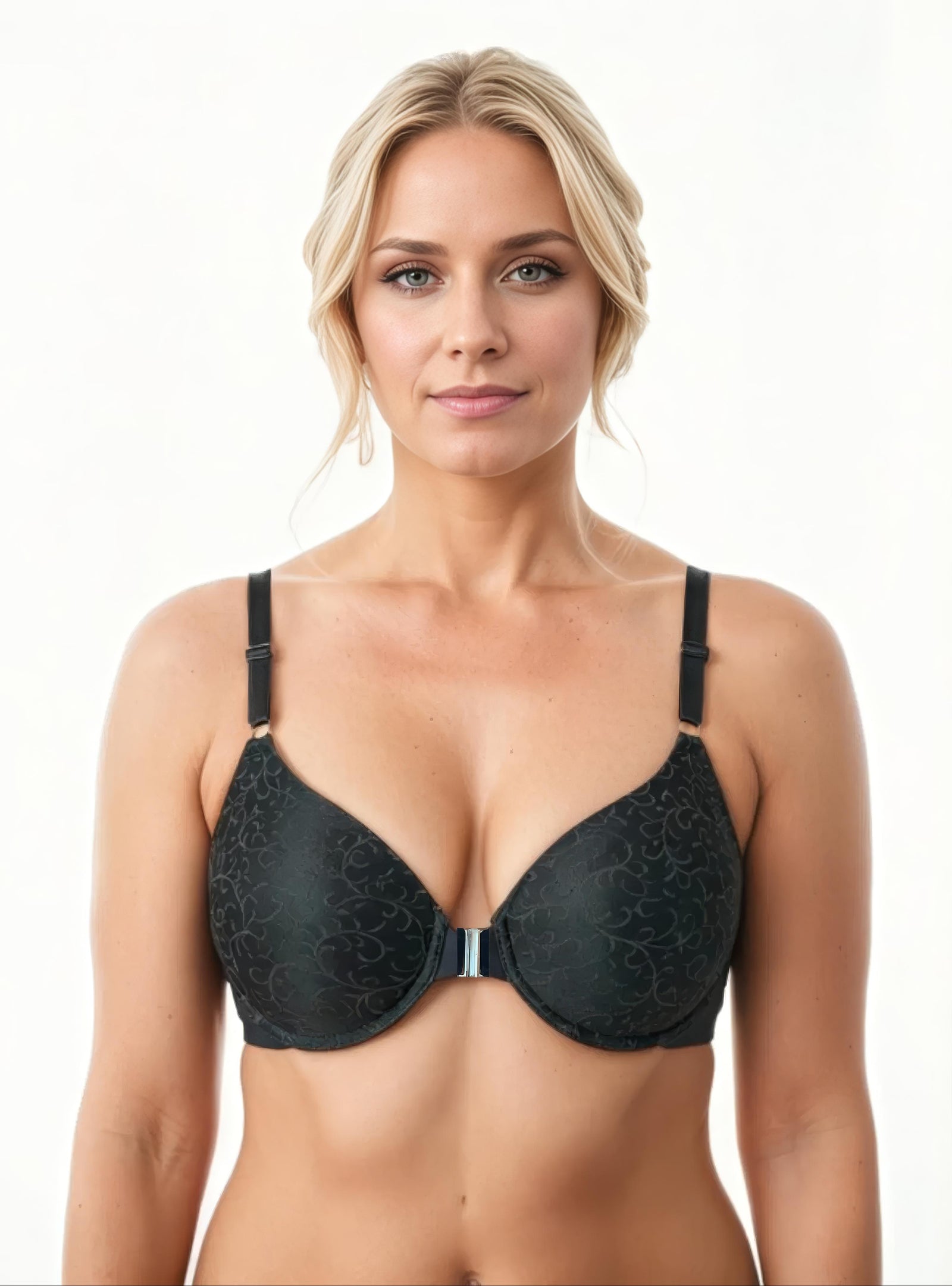
A correctly fitted Shapeez bra reduces back bulges and eliminates visible bra lines under fitted tops through its patented smooth-back design and comprehensive 360° smoothing and support. Traditional bras rely on narrow one-to-two-inch elastic bands that concentrate tension across the mid-back, creating muffin top and back fat. We replace that narrow band with broad, seamless back coverage that spreads the anchoring tension across your whole torso.
Since Staci Berner founded us in 2005 we have put 20+ years of fit expertise into every style, including our breathable, moisture-wicking Cool Tex Lycra. Choose from molded underwire styles like The Ultimate, non-foam options like the Silkee Short, or longline shapers like the Tankee Long to get all-day comfort without layering separate shapewear. Band sizes range from XS to 1X and cup sizes from AA to DDD/F. Learn more about our heritage on the Shapeez Story Page.
What should you do after finding your true bra size?
Once you have determined your baseline measurements, implement your size through a structured three-step process: measure accurately, test using the fit checklist, and adjust only one variable at a time if refinement is needed.
Put on your chosen bra and check that the band rests low and level across your back. Fasten conventional bras on the loosest hook so you can tighten the band as the elastic relaxes over time. Ensure the center gore sits flat against your sternum and your breast tissue sits fully contained within the cup boundaries without overflowing. Remember that comfort, supportive lift, and a level band matter far more than attachment to any single cup letter on a label.