Your Cart is Empty





A bra should not be the hardest part of getting dressed. Yet for many women, reaching behind the back, wrestling with tiny hooks, and dealing with a band that rolls or creates lines under clothing is a daily frustration. No hook bras offer a different approach: easier wear, fewer pressure points, and, when designed well, the smooth coverage that helps you feel confident in the clothes you already love.
The phrase can mean a few different things, though. Some no hook bras pull on over the head, some step into from the bottom up, and others use a front closure rather than a traditional back clasp. The right choice comes down to your body, your mobility, the level of support you need, and whether a smooth back is high on your list.
No hook bras are bras without the standard row of hook-and-eye closures across the back. That simple change can make a meaningful difference for women who find traditional closures difficult, uncomfortable, or visually distracting beneath fitted tops.
A pull-on bra or bralette is the most familiar version. It relies on stretch fabric and a flexible underband to stay in place. A front-closure bra also eliminates back hooks, but it opens at the center front with a clasp, zipper, or other fastening. Then there are tank-style bras and bra-and-shaping garments that provide support through a wider, more smoothing construction rather than a narrow band alone.
Not every hook-free style delivers the same result. A lightweight pull-on bralette may feel wonderfully easy on a relaxed day, but it may not provide enough lift or containment for a fuller bust. On the other hand, a structured front-closure style with full coverage can offer the convenience of no back hooks while still giving you the support needed for work, travel, or all-day wear.
Back closures are not inherently bad. They allow a bra band to be adjusted as it stretches over time, and they work well for many people. But they also concentrate hardware and bulk in one place. If the band is too tight, too narrow, or poorly positioned, it can dig in and create visible indentations across the back.
For women with arthritis, shoulder discomfort, limited range of motion, or simply a dislike of twisting to fasten a bra, back hooks can turn a basic routine into a struggle. Even if you can reach them easily, the closure may feel irritating when you lean back in a chair, sit in the car, or wear a thin knit top.
The issue is often bigger than the hooks themselves. A conventional bra can create back and side bulge when the band is too small, the cup is too small, or the design lacks enough fabric to distribute support comfortably. Swapping the closure location helps, but a truly flattering result comes from the entire garment working together.
The most supportive no hook bras are designed around the way a bra actually carries weight. They use a stable underband, thoughtfully placed straps, supportive cup construction, and a back that stays smooth instead of cutting across the body.
For a fuller bust, look for full-coverage cups that keep breast tissue contained without forcing it toward the sides. Wider straps can help reduce shoulder pressure, but they are not a substitute for a supportive band. The band should do most of the work, sitting level around your torso without riding up in back.
If visible lines are a major concern, pay close attention to the back panel. A narrow elastic band can create a sharp transition under clothing. A wider, smoothing back with flexible fabric can distribute the fit more gently, helping clothing lie flatter. This is especially helpful under T-shirts, button-downs, fitted dresses, and lightweight sweaters.
Shapeez built its patented back-smoothing bra category around that need: support and coverage should not require accepting the look or feel of a digging back band. A bra can be easy to put on and still be engineered to smooth from more than one angle.
Pull-on bras are often the softest and simplest option. They can be especially comfortable for lounging, sleeping, recovery periods, low-impact movement, or days when you want gentle support without wires or hardware. Many women also appreciate that there is no clasp pressing against the back.
The trade-off is that a pull-on style must stretch enough to get over your shoulders or hips. If you have shoulder pain, limited arm mobility, or a larger bust, getting a tight pull-on bra into place can be more difficult than fastening a front closure. Stretch also has limits. A very stretchy bra may feel comfortable at first but provide less shaping and lift as the day goes on.
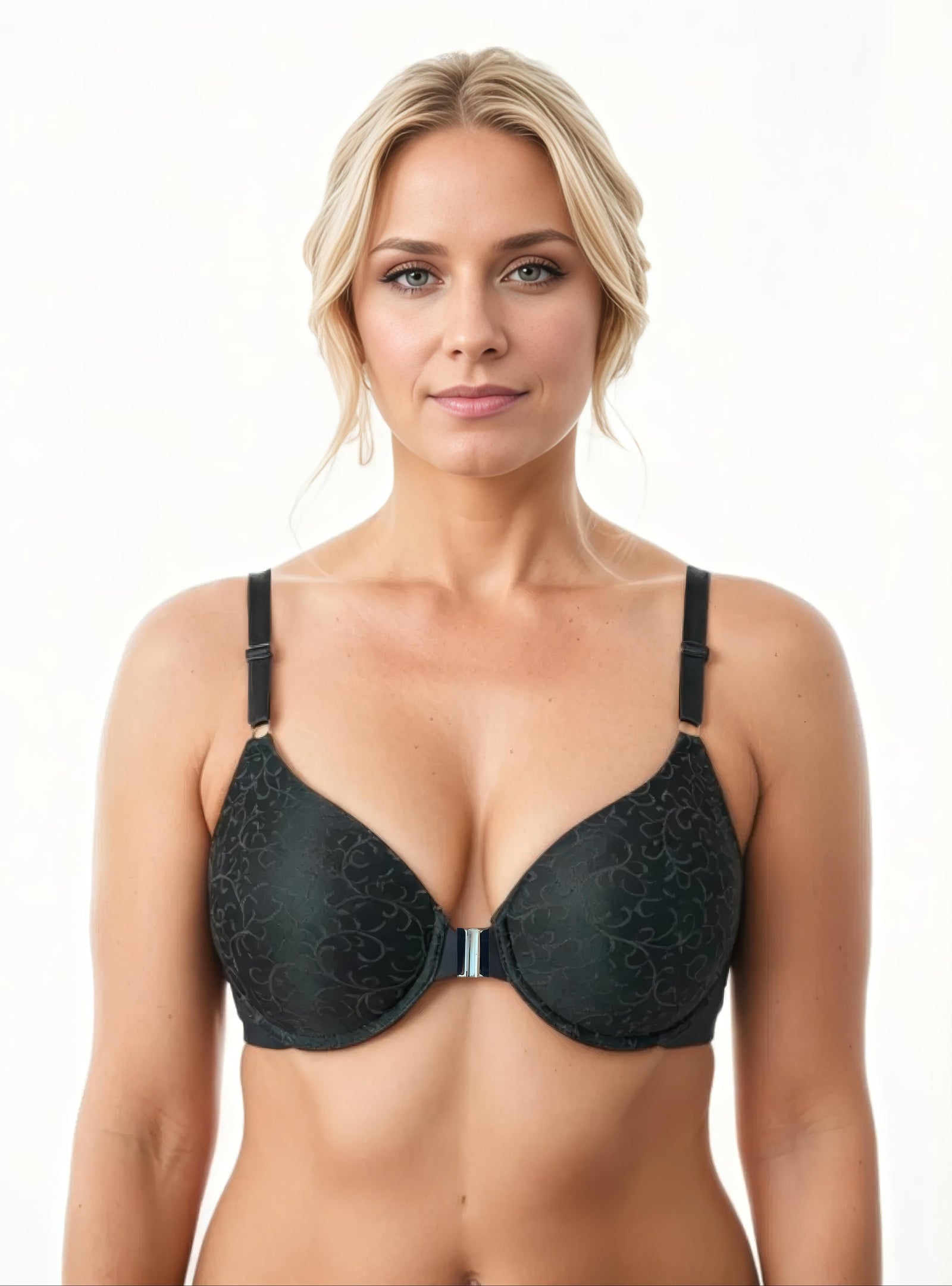
Front-closure bras are often easier to put on because you can see and reach the closure. They can be a practical choice for women who cannot comfortably twist behind their backs. Their fit depends on secure front hardware and a supportive frame around the cups, since there is no adjustable back closure to fine-tune the band.
A front closure can also create a cleaner back silhouette, but only if the back is wide enough and the fabric has the right amount of hold. Convenience alone is not the goal. You want a bra that stays in place, keeps you comfortably contained, and does not leave you counting the hours until you can take it off.
Start with the band. It should feel secure on the loosest setting if the bra has adjustable hardware, or comfortably firm if it is a pull-on design. You should be able to breathe, sit, and move naturally, but the band should not slide upward between your shoulder blades. If it does, it is likely too large or lacks enough support for your bust.
Next, assess the cups. Breast tissue should sit fully inside the cup without spilling over the top, side, or center. Gapping can mean the cup is too large, but it can also mean the bra shape is wrong for your breast shape. A cup that looks smooth while standing may still cut in when you sit or reach forward, so test the bra through normal movement.
Then check the sides and back under a close-fitting top. You are not looking for an airbrushed body. Bodies have softness, curves, and natural movement. You are looking for a garment that does not pinch, roll, or create harsh lines where your clothing should fall smoothly.
Finally, be realistic about the support level you need. A wire-free no hook bra can be an excellent everyday choice, particularly when it has a strong underband and structured cups. For high-impact exercise or a very full bust, you may need more encapsulation, firmer fabric, or a specialized sports design. Comfort should never mean settling for a bra that leaves you unsupported.
No hook bras are not automatically better for every occasion. If your size fluctuates often, a traditional adjustable back closure can offer useful flexibility. If you prefer a very precise band fit, or if you need maximum lift from a highly structured underwire bra, a hook-and-eye closure may still serve you well.
It also depends on how you dress. A low-back outfit may call for a different solution, while a front closure may show through a very thin, tight top. The goal is not to replace every bra in your drawer with one style. It is to find options that solve the frustrations you actually have.
A well-made no hook bra should feel like a reliable part of your wardrobe, not a compromise. Choose one that respects your need for easy dressing, smooth coverage, and real support, then let the rest of your outfit get the attention.