Your Cart is Empty



A bra can look beautiful on the hanger and still leave you counting the minutes until you can take it off. Cups that gap, bands that roll, straps that dig, and side bulge under a favorite top are not problems you should simply put up with. Learning how to measure bra cup size gives you a useful starting point for finding support that feels as good as it looks.
Your size is not a permanent label. Weight changes, hormonal shifts, pregnancy, aging, changes in activity level, and even the style of bra can affect your fit. A quick at-home measurement can help you shop with more confidence and recognize when your current bras are no longer giving you the comfort and smoothing you deserve.
You need a soft measuring tape, a lightly lined or non-padded bra, and a few uninterrupted minutes. If you do not have a soft tape, a piece of string and a ruler will work, though a measuring tape is more accurate.
Stand in front of a mirror with your shoulders relaxed. Avoid pulling the tape so tightly that it pinches, but do not let it sag. The goal is to capture your body as it is, not to measure yourself into a number you think you should wear.
Wrap the tape around your rib cage directly under your bust, where the bra band sits. Keep the tape level all the way around your body. Exhale normally, then record the measurement in whole inches.
For many bras, this underbust measurement is your starting band size. Some traditional sizing charts ask you to add inches to an odd number, but that method can create a band that is too loose to support you. A supportive band should sit firm and level around your torso, since it does most of the work of lifting and holding the cups in place.
If you measure 36 inches under your bust, start with a 36 band. If you measure between whole numbers, try the nearest band sizes around your measurement. For example, a 35-inch underbust may feel best in either a 34 or 36 depending on the bra’s fabric, closure, and level of stretch.
Now place the tape around the fullest part of your bust, usually across the nipple line. Keep it parallel to the floor and loose enough that it rests gently against your body without compressing breast tissue. Record this number in inches.
For the clearest result, measure while wearing a bra that gives light support but does not add padding or push your breasts together. A heavily padded bra can add volume to the measurement, while measuring without any support may shift breast tissue and make the result less consistent.
Subtract your band measurement from your bust measurement. The difference gives you a starting cup size. In common US sizing, each inch of difference generally represents one cup letter:
This is a starting point, not a verdict. Cup lettering is not universal across brands, especially above a D cup. A DD in one brand may fit more like an E or a DDD in another. Use your measurements to narrow your options, then let the fit of the actual bra guide your final choice.
A cup letter does not describe breast volume by itself. A 34D and a 40D do not have the same cup volume. As the band gets larger, the cup gets larger too, even though the letter stays the same.
This is why sister sizes can be helpful when one part of a bra fits but another does not. If a 36D cup fits well but the band feels too tight, try a 38C. If the 36D band feels too loose, try a 34DD. In both cases, you are adjusting the band while keeping a similar cup volume.
Sister sizing is useful for fine-tuning, but it should not be used to solve every fit issue. If the band is riding up your back or the cups are cutting into breast tissue, moving to a sister size may not fix the real problem. You may need a different bra shape, more coverage, a wider band, or a design with better side support.
The measuring tape cannot tell you everything. After you put on a bra, lean forward slightly and use your hand to guide each breast fully into the cup from the side and underneath. This is sometimes called swooping and scooping, and it helps you see whether the cup is truly containing your breast tissue.
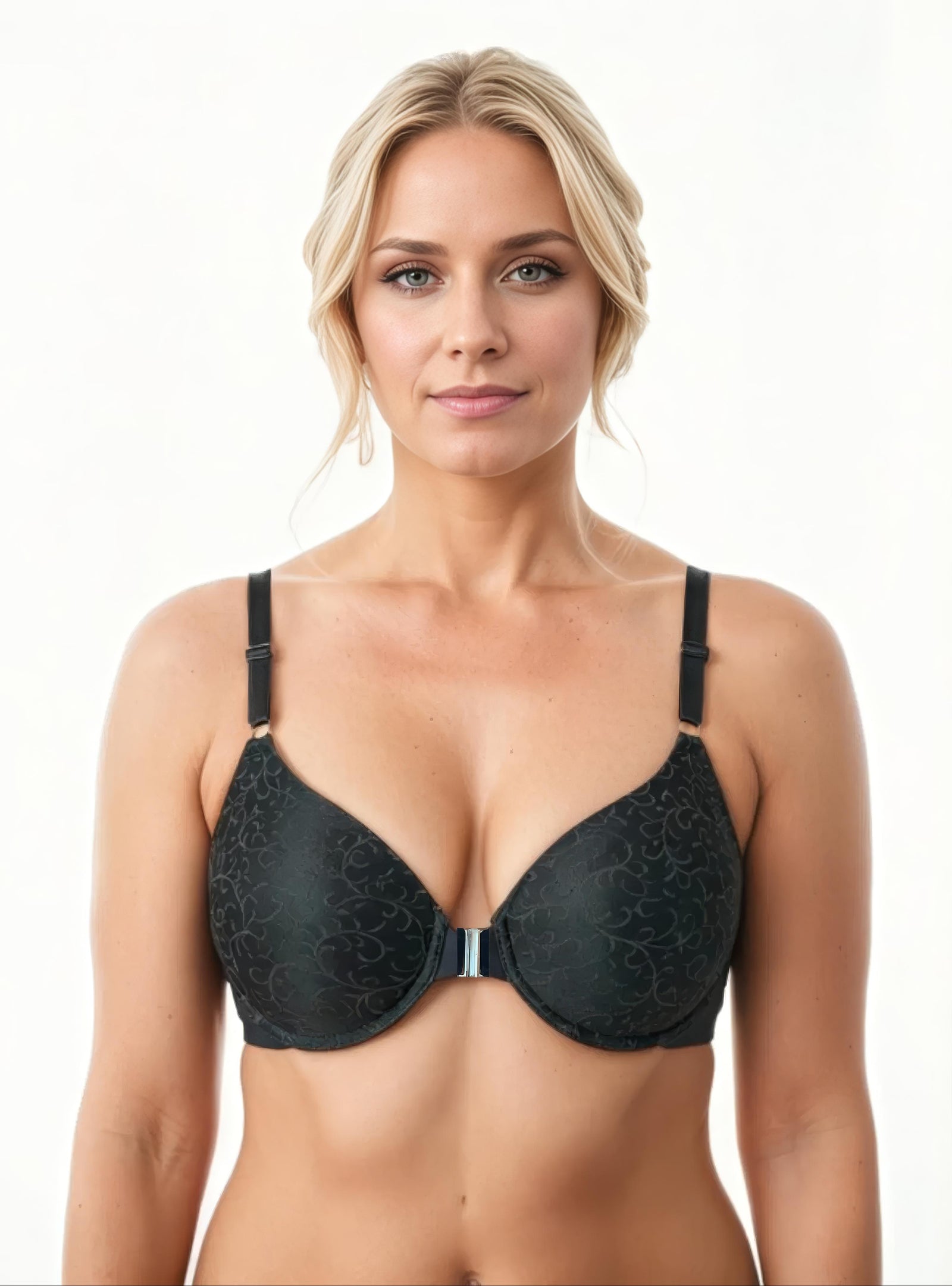
A well-fitting bra should feel secure without feeling restrictive. The center front should sit close to the chest in most underwire styles. The band should be level across the back rather than creeping upward. Straps should rest comfortably on your shoulders, not carry the full weight of your bust.
Look at the cups under a thin shirt, too. Gaping or wrinkling often means the cup is too large, too tall, or the wrong shape for your breast. Spillage at the top, sides, or underneath usually means the cup is too small or not full-coverage enough. A cup can technically be the right volume and still be the wrong shape, particularly if you have a fuller bust, softer tissue, or breasts that sit farther apart.
The most common mistake is measuring over a bulky sweater, padded bra, or shapewear that changes your natural shape. Measure close to the body over a light bra or thin camisole instead.
Another is holding the tape too loosely under the bust. A loose underbust measurement often leads to a loose band, and then the straps get tightened to compensate. That creates shoulder pressure without delivering the support you need.
It also helps to measure more than once. Take each measurement two or three times and use the number that appears most consistently. If your bust measurement varies slightly, that is normal. Choose the average, then use a fitting check to determine whether you need to move up or down in the cup.
Finally, do not assume your favorite old size is still your best size. Bras stretch with wear, and bodies change. If you constantly adjust your bra during the day, see visible lines under clothing, or feel relief the moment you unfasten it, reassessing your size is worth the time.
Cup size is only one part of comfort. For many women, the frustration is not just a cup that is too small or a band that is too tight. It is the back bulge, side spill, rolling edges, and hooks that make a bra feel like something to endure.
That is where construction matters. A wider, smoothing back can distribute pressure more comfortably than a narrow band. Full-coverage cups can help contain breast tissue that tends to spill at the sides. Front closures can be easier to manage for women with limited shoulder mobility, while wire-free styles may be the better choice when softness and flexibility are the priority. The best option depends on your shape, your daily routine, and how you want your clothes to fit.
Shapeez designs support with smoothing in mind, pairing bra function with shapewear-inspired coverage to help reduce the lines and bulges that traditional bras often leave behind. The goal is not to change your body. It is to give your body a more comfortable foundation.
Your measurements open the door, but your comfort gets the final say. When your band stays put, your cups contain without cutting in, and your back feels smooth under your clothes, you have found more than a size. You have found a bra that lets you move through the day feeling supported, polished, and completely yourself.