Your Cart is Empty




A bra can look perfectly fine from the front and still make getting dressed feel like work. If twisting to reach a back clasp, dealing with a rolling band, or seeing lines under your top has become part of the routine, the question of front closure versus hook bras deserves more than a quick answer. The best choice is not about what is more traditional. It is about what feels easier on your body, supports your bust, and helps your clothes lie the way you want them to.
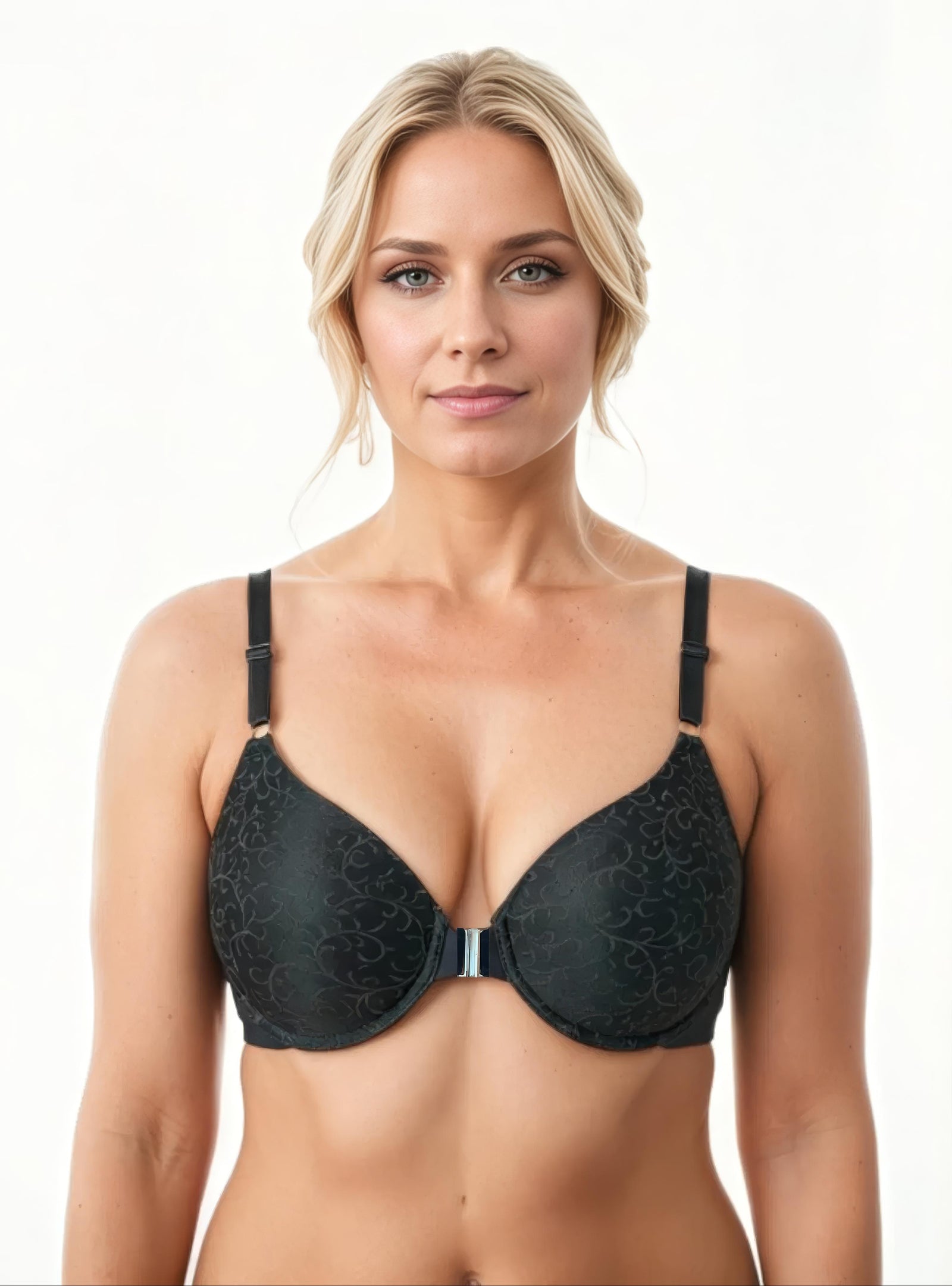
A front-closure bra fastens at the center of the chest, usually with a clasp, hook-and-eye mechanism, or a zippered design. A traditional back-hook bra fastens behind you and typically offers several rows of hooks for band adjustment. Both can be supportive. Both can be comfortable. The details of the design make the difference.
Front closures are often a welcome solution for women with shoulder stiffness, limited mobility, arthritis, or simply zero patience for reaching behind their backs before coffee. Because the closure is visible and accessible, getting dressed can feel more straightforward. They also tend to create a clean, uninterrupted back, which is especially valuable when you want less bulk and fewer visible lines under fitted tops.
Back-hook bras offer a familiar kind of flexibility. Multiple rows of hooks let you tighten the band as it naturally relaxes over time. For some women, that adjustability is reassuring, particularly when their size fluctuates or when they prefer a very specific band tension.
The right answer depends on what you need most: easy dressing, adjustable fit, a smooth back, fuller coverage, or a combination of all four.
The biggest benefit of a front closure is simple: you can see what you are doing. Instead of turning, stretching, and hoping the hooks line up, you fasten the bra at the front and go. That convenience matters after surgery, during periods of shoulder discomfort, or on any morning when a standard bra feels unnecessarily complicated.
A well-designed front-closure bra can also offer a smoother look across the back. Traditional hook-and-eye closures add a small panel of hardware at the center back. On a bra that is too tight, that panel can contribute to a noticeable line or a pinched feeling. The clasp itself is not always the problem, but it can be part of a construction that does not distribute tension evenly.
That is where a smoothing silhouette changes the experience. Shapeez designs bras with patented 360° back-smoothing construction, helping the band sit more evenly across the back and sides rather than cutting in at one narrow point. The goal is not to change your body. It is to let your bra support you without announcing itself through your clothing.
Front-closure styles can be particularly helpful if you want a clean back under knit tops, dresses, or lightweight fabrics. They are also a strong choice for women who dislike the feeling of straps and closures competing for space across the shoulder blades.
A front closure usually has less room for day-to-day band adjustment. Since many styles close in one fixed position, getting the initial fit right is essential. Your band should feel snug and secure on the loosest setting available, without digging, rolling, or making it hard to take a comfortable breath.
Some front-closure bras can also create a more centered bust shape, depending on the cup and strap placement. That may be exactly what you want under certain clothes. If you prefer more separation or have a fuller bust, look for full-coverage cups, supportive side panels, and wide, stable straps rather than assuming every front closure will fit the same way.
Back-hook bras are popular for good reason. The multi-row closure gives you a practical way to fine-tune the band over the life of the bra. A new bra should fit securely on its loosest hook, then move inward as the fabric gradually relaxes. That built-in adjustment can extend wear and help you maintain support.
For women whose weight, hormones, medication, or activity levels cause regular size changes, this flexibility may be useful. If your ribcage measurement varies from week to week, several hook positions can offer more breathing room than a fixed front clasp.
Traditional back closures also come in a wide range of cup shapes and support levels. If you have spent years wearing back-hook bras and know exactly which cup style works for you, there is no reason to switch just because front closures are easier to fasten. Comfort is personal, and a familiar bra that fits beautifully is worth keeping in rotation.
Still, a back-hook bra should not leave deep marks, create a ridge across your back, or require you to pull the band excessively tight for support. Those signs often point to a fit issue, an overly narrow band, or a design that is carrying the weight of the bust in the wrong places.
One common misunderstanding is that front-closure bras are automatically less supportive than back-hook bras. Closure placement alone does not determine support. The band, cup structure, fabric recovery, strap placement, and side support all work together.
A supportive front-closure bra needs a secure center clasp, a firm but flexible underband, and enough coverage to keep breast tissue comfortably contained. Wire-free styles can provide excellent everyday support when the fabric and shaping panels are engineered to lift and hold. Underwire styles may offer more defined lift for some bodies, but wire-free can be the better choice when comfort, flexibility, or sensitivity is the priority.
Likewise, a back-hook bra with multiple adjustment rows is not automatically a better fit. If the cups are too small, the band is too loose, or the straps are doing all the lifting, more hooks will not solve the problem. A bra should feel supported from the band around your torso, not from straps that dig into your shoulders by lunchtime.
Whichever closure you choose, pay attention to how the bra behaves during a normal day. Raise your arms, sit down, reach for something, and look at the back under a thin shirt. The band should stay level. The cups should hold you without spilling, gaping, or pressing uncomfortably into breast tissue. Straps should stay put without carrying all the weight.
If the bra rides up in back, the band is likely too loose. If it creates pronounced digging or you cannot comfortably wear it for several hours, the band may be too tight or the style may not distribute pressure well. A smooth-looking bra should also feel smooth. You should not have to choose between a polished silhouette and being able to relax.
Think about when and where you will wear the bra. A front-closure, back-smoothing style can be ideal under close-fitting tees, sweaters, and dresses where you want the back and sides to look clean. It can also make sense for travel, busy mornings, and days when shoulder mobility is limited.
A traditional back-hook bra may be a better match when you want maximum adjustability or are shopping for a highly specific cup style. It can be a dependable option for workwear, special-occasion outfits, and any time you already know that a certain back-hook fit works for your body.
Many women benefit from owning both. This is not an either-or decision for every day of the week. A front closure can be the bra you reach for when ease and smoothing are nonnegotiable, while a back-hook option may serve you well when you want more adjustment range.
The most flattering bra is the one you stop thinking about once it is on. Choose the closure that makes getting dressed feel simpler, lets you move comfortably, and gives you the quiet confidence to focus on everything else.